
L'intelligence de décision IA pour les directeurs techniques
Suivre les décisions qu'on ne peut pas défaire
- La plupart des directeurs techniques suivent leurs décisions IA ouvertes entre infolettres, fils Slack et requêtes ChatGPT ponctuelles — dont aucun ne répond à « ai-je toujours raison sur ce point ? »
- Se tromper sur le déploiement des outils de codage IA, la standardisation d'un cadriciel ou l'arbitrage construire-ou-acheter sur les agents coûte 3 à 6 mois d'ingénierie. Manquer un mouvement concurrent, c'est le conseil où votre dirigeant l'a su avant vous.
- L'intelligence de décision IA est une catégorie nouvelle : des outils ancrés sur une courte liste nommée de vos décisions ouvertes, qui réargumentent chacune à mesure que des preuves arrivent.
- AIssential Counsel réargumente chaque décision ouverte, répond à vos questions ciblées avec des citations verbatim, et nomme les décisions sur lesquelles rien n'a bougé cette semaine.
- Le Brief quotidien gratuit couvre la veille générale. Counsel est à 99 €/mois en Solo, forfaitaire — toutes vos décisions, sans quota, sans calcul.
En 2026, toute entreprise en série A à C qui construit avec l'IA a le même problème à l'étage dirigeant : 3 à 5 décisions ouvertes, chacune avec 3 à 6 mois de reprise si elle est mauvaise. La pile de codage IA que vous standardisez dans l'équipe. Le choix de cadriciel pour l'orchestration d'agents. Construire ou acheter le cadre d'évaluation. Le recrutement ML. Le concurrent nommé dont les rumeurs de feuille de route atterrissent dans vos messages.
Vous lisez des infolettres. Vous surveillez le canal #ai-news de votre équipe. Vous interrogez Perplexity. Vous demandez à Claude. Vous parcourez des rapports d'analystes. Aucun de ces outils n'a été bâti pour la question qui vous tient réellement éveillé : « ai-je toujours raison sur ce point ? »
Ce guide compare la façon dont les directeurs techniques et responsables IA suivent leurs décisions ouvertes en 2026 — infolettres, agents conversationnels généralistes, canaux Slack internes, rapports d'analystes, et la nouvelle catégorie des plateformes d'intelligence de décision — et montre où chacun casse. Nous terminons par la place qu'y tient AIssential Counsel, puisque c'est la catégorie pour laquelle nous l'avons construit.
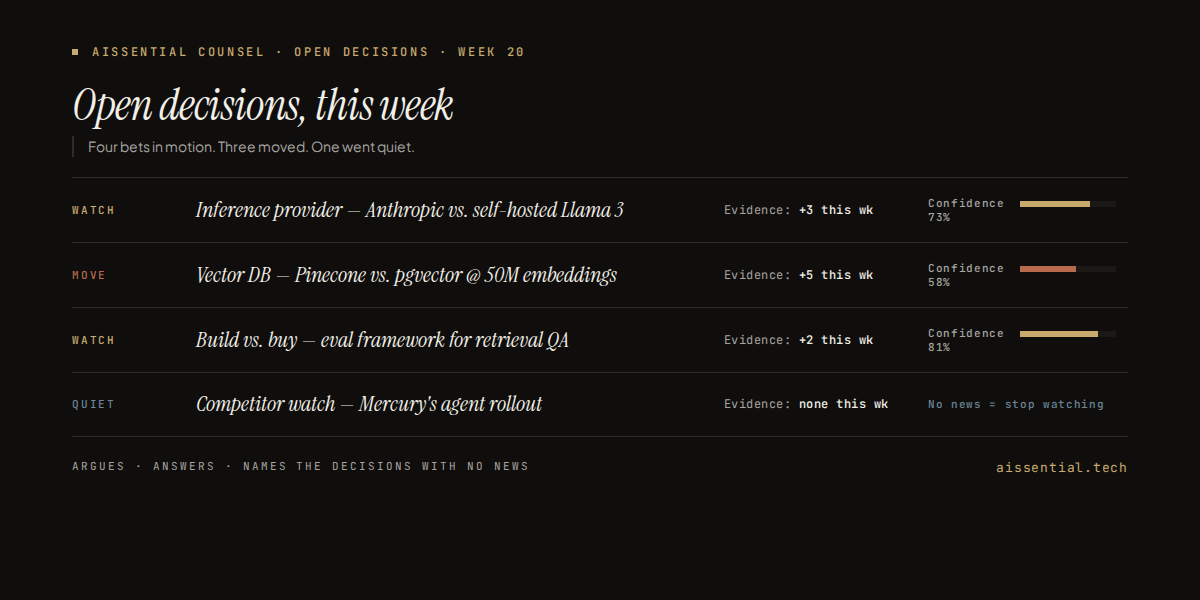
Qu'est-ce que l'intelligence de décision IA ?
L'intelligence de décision IA est une catégorie d'outils conçus pour suivre et réargumenter les décisions d'infrastructure IA qu'un responsable technique a déjà prises, à mesure que de nouvelles preuves arrivent. Elle se situe un cran au-dessus d'un agrégateur d'actualité, un cran en dessous d'une relation avec un cabinet d'analystes.
Un agrégateur généraliste vous dit ce qui est nouveau. Un moteur de recherche répond à ce que je veux savoir maintenant. Aucun des deux n'est ce dont un directeur technique a besoin une fois la décision prise. La question difficile, semaine après semaine, est :
- Une de mes décisions ouvertes a-t-elle bougé cette semaine ?
- Les arguments pour ou contre ont-ils changé ?
- Lesquelles n'ont eu aucune actualité — et est-ce une confirmation, ou est-ce que je ne vois simplement pas la bonne source ?
Un outil d'intelligence de décision est ancré sur une courte liste nommée de décisions que vous avez explicitement cadrées : « Devons-nous standardiser un seul outil de codage IA dans toute l'équipe, ou rester multi-outils ? », « Construire l'orchestration d'agents en interne ou adopter LangGraph ? », « Recruter un second ingénieur ML ou sous-traiter le cadre d'évaluation ? » Chaque sortie de l'outil est jugée contre cette liste — pas contre un intérêt général pour l'actualité IA.
La catégorie est nouvelle. La plupart des directeurs techniques font encore ce travail à la main, avec les outils ci-dessous.
Comment on suit ses décisions IA aujourd'hui
Les infolettres IA (The Rundown AI, TLDR AI, AlphaSignal, The Batch)
Elles restent l'apport quotidien le plus rentable pour un responsable technique, et gratuitement, elles sont difficiles à battre. The Rundown AI avec plus de 1,75 million d'abonnés et TLDR AI avec plus de 900 000 livrent des synthèses quotidiennes serrées ; AlphaSignal va plus loin pour les chercheurs ; The Batch apporte le poids éditorial d'Andrew Ng une fois par semaine.
Ce qu'elles apportent : une conscience générale du terrain, les mouvements de premier plan, la connaissance de ce dont le milieu parle.
Où elles cassent pour un directeur technique avec des décisions ouvertes :
- Une sélection éditoriale figée. Vous lisez ce que le rédacteur a choisi, pas ce qui recoupe votre pile.
- Aucune reprise contre vos décisions. L'annonce tarifaire d'Anthropic qui compte pour l'une de vos décisions est noyée parmi quinze éléments qui ne comptent pas.
- Aucune mémoire du silence. Elles ne peuvent pas vous dire « rien n'a bougé cette semaine sur la standardisation de cadriciel que vous finalisez », puisqu'elles ignorent ce que vous décidez.
Pour un panorama complet du paysage des infolettres, voir notre comparatif 2026 des infolettres, podcasts et chaînes IA.
Les canaux Slack internes et les pages Notion
La solution maison par défaut. Un canal #ai-watch où l'équipe dépose des liens, une page Notion avec un journal des changements tarifaires des outils de codage IA, quelques rappels Slack programmés le lundi.
Ce que ça apporte : la coordination d'équipe, la capture du savoir informel, la trace des décisions au fil de l'eau.
Où ça casse :
- Une sélection biaisée à l'entrée. Les liens déposés sont ceux que quelqu'un a vus passer, pas ceux qui recoupent vos décisions ouvertes.
- Aucune couche de raisonnement. Le canal collecte des preuves ; personne ne réargumente la décision sous-jacente. Le fil grossit, la décision dérive, personne n'est tenu de réévaluer.
- Aucune couche de silence. Une semaine calme se lit comme « tout va bien », alors qu'une fois sur deux, elle signifie que l'équipe est en production et ne lit rien.
Les agents conversationnels généralistes (ChatGPT, Claude, Perplexity)
L'outil le plus rapide du lot pour une recherche ponctuelle. « Où en est la tarification entreprise de Cursor ? » « LangChain a-t-il livré de nouvelles primitives d'agent ce trimestre ? »
Ce que ça apporte : des réponses uniques, quand vous savez déjà quoi demander.
Où ça casse pour un suivi continu :
- Fonctionnement à la demande. Vous n'obtenez une réponse que si vous pensez à poser la question. Or tout l'intérêt de l'intelligence de décision est que la question soit posée pour vous, selon un rythme, contre les mêmes décisions cadrées.
- Des citations superficielles. Perplexity est le meilleur des trois sur l'ancrage, mais la récupération d'un passage verbatim correspondant à l'affirmation reste inégale.
- Aucune notion de vos décisions ouvertes. Chaque requête part de zéro. Aucun contexte persistant du type : « cet utilisateur suit la standardisation de sa pile de codage IA ; voici les quatre sous-questions qu'il a cadrées ».
Les rapports d'analystes (Gartner, Forrester, IDC, a16z, Bessemer)
Pour certaines décisions, notamment celles proches de l'achat, ces rapports portent encore. Un quadrant Gartner sur les bases vectorielles est une pièce qui compte dans une évaluation de fournisseur en grande entreprise.
Ce qu'ils apportent : la présélection de fournisseurs, la vérification croisée de vos conclusions, l'ancrage d'un discours devant un conseil.
Où ils cassent :
- La latence. Un rapport Gartner paraît au mieux chaque trimestre. La demi-vie d'une position sur « construire ou acheter l'orchestration d'agents en entreprise » en 2026 se mesure en semaines, pas en trimestres.
- Un cadrage générique. Le rapport est écrit pour une catégorie, pas pour votre pile à votre échelle.
- Le coût et le cycle d'achat. Obtenir le rapport prend plus de temps que la demi-vie de son analyse.
Les tableaux de bord internes sur mesure
Quelques grandes équipes ont construit quelque chose : un tableau Looker au-dessus d'une chaîne RSS, un outil interne de suivi d'évaluations, une présentation hebdomadaire maintenue par le responsable plateforme.
Ce que ça apporte : l'équipe qui le construit obtient exactement ce qu'elle veut.
Où ça casse : toutes les autres équipes. Le coût de construction est d'un à deux trimestres d'ingénieur, le coût d'entretien est perpétuel, et le jour où le responsable plateforme change de poste, le tableau pourrit.
Ce qu'un outil d'intelligence de décision doit réellement faire
Si vous êtes directeur technique avec 3 à 5 décisions IA ouvertes, l'outil qui résout le problème doit faire trois choses que les précédents ne font pas.
1. Réargumenter chaque décision à mesure que les preuves arrivent
Pas « envoyer des articles pertinents ». Réargumenter la décision : redire les arguments tels qu'ils étaient au moment du choix, parcourir les preuves nouvelles, et dire si elles renforcent ou affaiblissent la décision. Chaque affirmation citée d'un passage verbatim. La sortie est une note, pas un fil.
2. Répondre à vos questions les plus difficiles, cadrées sur la décision
Quand vous demandez « la tarification entreprise Tier 4 d'Anthropic a-t-elle changé ces 30 derniers jours ? », la réponse est ancrée dans les articles, billets et modifications de pages tarifaires survenus dans la fenêtre — pas dans une supposition tirée de la date d'entraînement du modèle. Chaque affirmation citée.
3. Nommer les décisions sans actualité
La moitié de la charge mentale de cinq décisions ouvertes n'est pas « qu'est-ce qui a bougé », mais « rien n'a bougé, ou bien je ne l'ai pas vu ? ». Un outil qui fait les deux premières tâches et saute celle-là laisse sans réponse la pire des questions. Le travail consiste à vous dire : « rien n'a bougé cette semaine sur le déploiement de votre pile de codage, sur votre standardisation de cadriciel, sur votre arbitrage construire-ou-acheter ». Confirmer un silence vaut autant que confirmer une nouvelle.
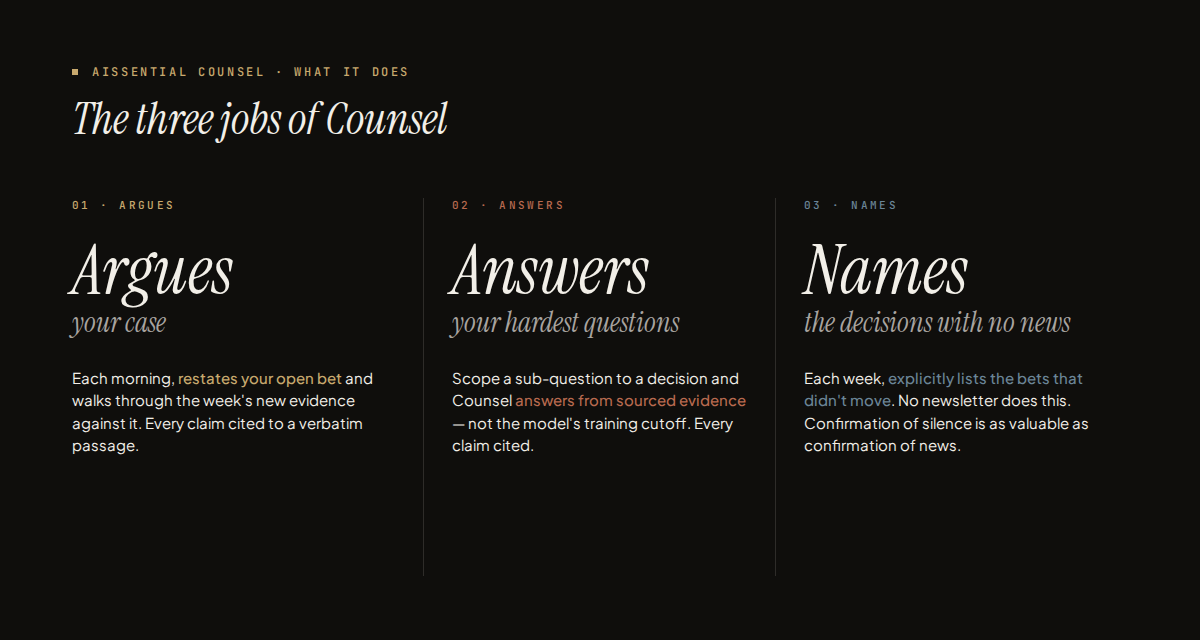
AIssential Counsel
Counsel est le brief Pro d'AIssential. Il accomplit les trois tâches ci-dessus contre les décisions IA que vous avez explicitement cadrées — pour que vous entriez dans chaque conseil, chaque évaluation de fournisseur et chaque revue d'architecture avec le bon contexte, pas les derniers titres.
- Il argumente votre position. Chaque matin, Counsel reformule chaque décision ouverte et parcourt les preuves nouvelles de la semaine. Chaque affirmation est citée d'un passage verbatim issu de plus de 500 sources suivies : laboratoires, blogs d'ingénierie, pages tarifaires, levées de fonds, dépôts réglementaires, offres d'emploi.
- Il répond à vos questions difficiles. Cadrez des sous-questions sur une décision (« Cursor a-t-il annoncé un changement tarifaire ce trimestre ? », « où en est la feuille de route d'orchestration d'agents de LangChain ? ») et Counsel répond depuis le même corpus sourcé.
- Il nomme les décisions sans actualité. Chaque brief liste explicitement les décisions ouvertes et les sujets suivis qui n'ont pas bougé. Aucune infolettre ne fait ça. L'objectif est de réduire votre inquiétude active de cinq décisions à la seule qui a réellement bougé.
Dessous : plus de 500 sources IA lues chaque matin. Chaque affirmation ancrée dans un passage verbatim. Chaque sortie structurée en note, pas en fil.
L'offre gratuite — le Brief quotidien — vous donne 7 articles frais à fort signal chaque matin, classés par palier de source, intention et profondeur, lus en 5 minutes. Cela couvre la tâche « quoi de neuf en IA ». Counsel se place au-dessus, pour la tâche « ai-je toujours raison sur mes décisions ouvertes », que l'offre gratuite ne cherche pas à résoudre.
Quand Counsel s'impose, et quand une infolettre suffit
Counsel est bâti pour un moment précis : vous avez au moins une vraie décision d'infrastructure IA où se tromper coûte des mois d'ingénierie, et vous perdez du temps dans la boucle « ai-je toujours raison ? »
Passez votre chemin si :
- vous suivez l'IA par intérêt général, pas comme des décisions cadrées. Une infolettre gratuite convient mieux ;
- les décisions sont prises et l'entreprise ne compte pas les rouvrir cette année. La valeur de Counsel se cumule quand les décisions sont en mouvement ;
- rien de réel n'en dépend — aucune décision en jeu, aucun coût de reprise. Perplexity ou Claude répondront très bien.
Adoptez-le si :
- vous menez 1 à 3 décisions IA ouvertes où le coût de reprise est réel ;
- votre dernier conseil a comporté une question dont vous n'aviez pas les données à jour ;
- une mauvaise décision sur le déploiement des outils de codage, la standardisation d'un cadriciel ou l'arbitrage construire-ou-acheter coûterait 3 à 6 mois à votre équipe. (Ce serait le cas de la plupart.)
Tarifs et mise en route
- Gratuit — Brief quotidien. 7 articles frais à fort signal chaque matin, classés par palier de source, intention et profondeur. Filtrage par rôle, sujets et format. Lu en 5 minutes.
- 99 €/mois en Solo (ou 79 €/mois en facturation annuelle) — le Brief quotidien, plus Counsel sur toutes les décisions que vous apportez. Sans quota, sans calcul.
Passez-le en note de frais. Aucun processus d'achat. Inscrivez-vous sur aissential.tech →
Le second avis sur vos décisions IA.
Prenez la décision IA que vous pourrez défendre.
Essayer AIssential gratuitement →